Commercial Plumbing
Pipe Bursting Services in LA & Orange County, California
Fanti Sewer & Drains uses pipe bursting to fully replace damaged sewer, drain, and water lines without open-cut excavation across your property. A new pipe is pulled through the path of the old one while a bursting head fractures and displaces the original pipe outward, so you get a brand-new line without a trench running the full length of your yard, driveway, or landscaping.
This method is often the right call when a line is too damaged for lining — collapsed sections, severe offsets, major cracking, undersized pipe, or a line that’s simply beyond rehabilitation.
Every line is inspected before we recommend pipe bursting. Some pipe paths, materials, or nearby utilities may call for a different trenchless method or traditional excavation.
What Is Pipe Bursting?
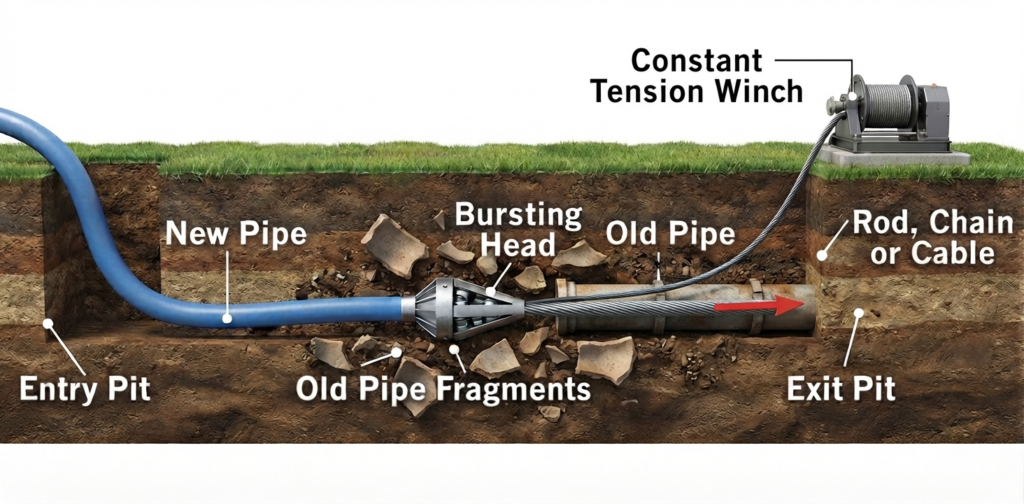
Pipe bursting is a trenchless replacement method that installs a brand-new pipe in the exact path of an existing one. Rather than digging up the old line, we insert a bursting head connected to the new pipe and pull the entire assembly through the old line using a hydraulic or pneumatic pulling system.
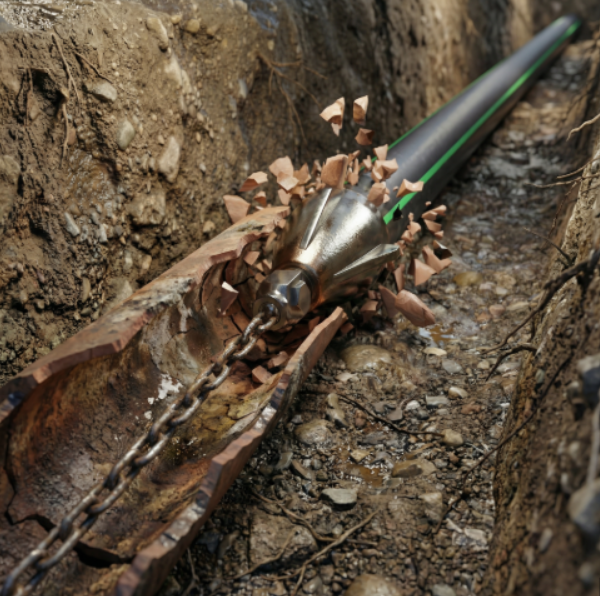
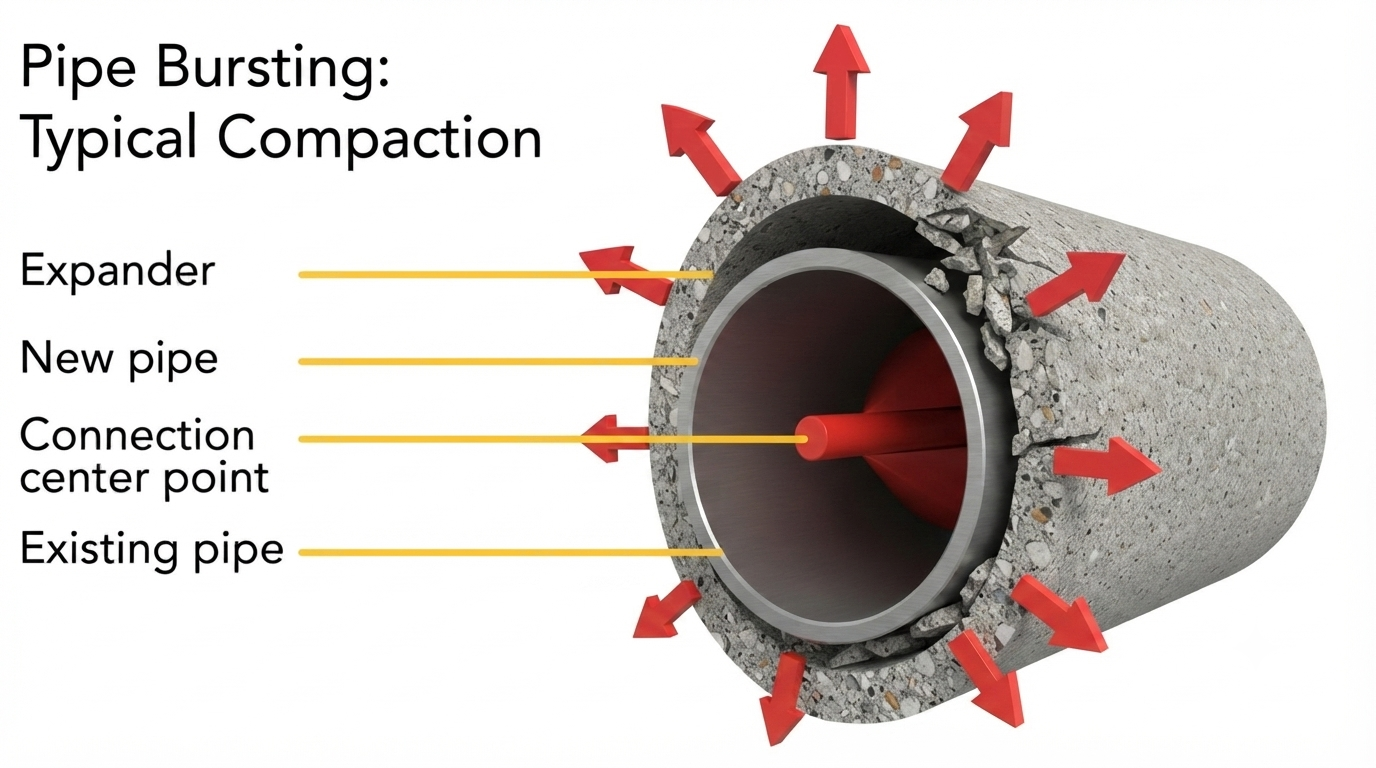
As the bursting head moves through the old pipe, it fractures the original material and forces the fragments outward into the surrounding soil, opening a path for the new pipe to follow directly behind it. By the time the head reaches the pulling pit, the old pipe is gone and a continuous new pipe occupies its place.
Because the new line is a single continuous run rather than a repaired section, it goes in without the joints that older pipe materials often fail at.
Important Distinction
Pipe bursting is a full replacement, not a repair or a lining. It’s the right call when the existing pipe can’t be salvaged or rehabilitated, and a same-size or larger-diameter line is being installed in its place.
Depending on pipe material, depth, soil conditions, and nearby utilities, we may recommend static (pulled) bursting or pneumatic (hammer-impact) bursting for a given project.
Purpose-Built Equipment for Full Pipe Replacement
Fanti Sewer & Drains uses hydraulic and pneumatic bursting systems designed to fracture a range of pipe materials while pulling new HDPE pipe into place behind the bursting head.
Our equipment is sized to the project, pulling force, bursting head diameter, and pipe material are all matched to the line being replaced and the new pipe going in.
We plan entry and exit pits, pulling distances, and ground conditions before mobilizing equipment, so the pull goes through in a single continuous run whenever possible.
Handles Multiple Pipe Materials
Cast iron, clay, concrete, and older plastic pipe can all be fractured and replaced using the appropriate bursting method and head.
Same-Size or Upsized Replacement
Pipe bursting can replace a line with a new pipe of the same diameter, or upsize it where added capacity is needed.
Joint-Free HDPE Pipe
Testing, repair, and installation of backflow prevention devices to meet local code requirements.
Minimal Surface Disruption
Only entry and exit pits are excavated, keeping landscaping, driveways, and hardscape largely intact compared to open trenching.
Static and Pneumatic Options
We select a pulled (static) or impact (pneumatic) bursting method based on pipe material, ground conditions, and proximity to other utilities.
Post-Installation Verification
Once the new line is in place, we run a camera through it to confirm alignment, diameter, and condition before backfilling and reconnecting service.
Candidacy
Pipe Conditions That Are Candidates for Pipe Bursting
Pipe bursting is considered when a line is too damaged, undersized, or misaligned to be rehabilitated through lining, and when the pipe’s path is clear enough to pull a new line through.
Collapsed or Crushed Sections
A pipe that's lost its shape can't be lined — it needs to be replaced. Bursting can fracture and clear the damaged section as the new pipe is pulled through.
Severe Cracking or Fragmentation
Extensively cracked or fragmented pipe, especially clay or aging cast iron, is often a stronger candidate for replacement than repair.
Major Offsets and Misalignment
Sections that have shifted out of alignment — from root intrusion, ground movement, or age — can be replaced with a continuous new line rather than patched.
Undersized Pipe
If a line's original diameter is no longer adequate for current or planned usage, bursting allows us to upsize the pipe without a full trench dig.
Chronic Root Intrusion
Pipe with recurring root damage at multiple joints is often better served by a joint-free replacement than repeated cleaning and spot repairs.
Materials Beyond Rehabilitation
Older pipe materials that have degraded structurally not just internally usually aren't candidates for lining and need full replacement.
Long, Continuous Runs
Bursting is well suited to longer straight or gently curved runs where a single continuous pull can replace the full line.
Under Driveways, Yards, and Hardscape
Because only entry and exit pits are needed, bursting is often preferred for lines running under driveways, landscaping, or other finished surfaces that owners don't want fully trenched.
Pipe bursting isn’t the answer for every line. Pipe with very tight bends, limited access for a pulling pit, nearby utilities that are too close for safe fracturing, or a path that can’t tolerate ground displacement may need a different trenchless method or open excavation.
Our Process
How Fanti Sewer & Drains Performs Pipe Bursting
We treat inspection, planning, excavation, bursting, and verification as one connected job, not separate stages.
01
CCTV Inspection and Condition Assessment
We start with a camera inspection to document pipe material, diameter, depth, path, bends, and the extent of damage. This tells us whether bursting is the right method or whether lining or another repair makes more sense.
02
Utility Locating and Path Planning
Before any excavation, we locate nearby utilities and map the pipe's path to confirm it's clear for a bursting head to travel through safely.
03
Entry and Exit Pit Excavation
We dig the access pits needed to insert the bursting head and receive the new pipe on the other end — typically the only excavation required for the entire job.
04
Equipment Setup and Calibration
We set up the pulling system, select the appropriate bursting head for the pipe material, and prepare the new HDPE pipe for the pull.
05
New Pipe Fusion
Sections of HDPE pipe are fused into a single continuous length matched to the run, so there are no joints along the new line once it's installed.
06
Bursting and Pipe Pulling
The bursting head is pulled or driven through the old pipe, fracturing it and displacing the fragments outward while the new pipe is drawn into place directly behind it.
07
Monitoring During the Pull
We monitor pulling force, progress, and ground conditions throughout the pull, adjusting as needed for changes in soil or pipe material along the run.
08
Reconnections
Once the new line is in place, we reconnect it to the building's plumbing, laterals, or the main line as required, restoring full service.
09
Backfill and Surface Restoration
Entry and exit pits are backfilled and compacted, and any disturbed surface — landscaping, pavement, or hardscape — is restored.
10
Post-Installation CCTV Verification
We run a final camera pass through the new line to confirm alignment, diameter, and condition before considering the job complete, with documentation available if needed.
FAQ’s
Your Questions About Pipe Bursting
How is pipe bursting different from pipe lining?
Lining rehabilitates the inside of an existing pipe. Pipe bursting fully replaces the pipe — the old one is fractured and displaced while a new pipe is pulled into its place. We evaluate the line before recommending either method.
Does pipe bursting require digging up my whole yard?
No. In most cases, only two access pits — one at each end of the run — are needed, rather than a trench along the pipe’s full length.
Can pipe bursting increase my pipe's diameter?
Yes, in many cases. Bursting can install a new pipe the same size as the old one or upsized for added capacity, depending on the project.
What pipe materials can be replaced with bursting?
Cast iron, clay, concrete, and many older plastic pipes can be fractured and replaced. We confirm candidacy after inspection.
Is pipe bursting safe near other utilities?
We locate nearby utilities before starting and won’t recommend bursting where the fracturing process could risk damage to lines or structures too close to the path.
How long does a pipe bursting job take?
It depends on pipe length, material, depth, and site access. Many residential jobs can be completed faster than a comparable open-trench replacement, but we’ll give you a real timeline after an on-site assessment.
Will pipe bursting damage my landscaping or driveway?
Surface disruption is generally limited to the entry and exit pits, which is significantly less than trenching the full pipe run — though some restoration work is still typically needed at those pit locations.
Is pipe bursting structural?
Yes. The result is a brand-new pipe, not a coating or rehabilitation of the old one, so it carries the full structural integrity of new HDPE pipe.
Pipe Evaluation
Find Out Whether Your Pipe Is a Candidate for Bursting
Don’t commit to full open-trench replacement before your line has been inspected. Fanti Sewer & Drains can evaluate your pipe, walk you through what the camera shows, and tell you plainly whether pipe bursting or another repair method is the right call.